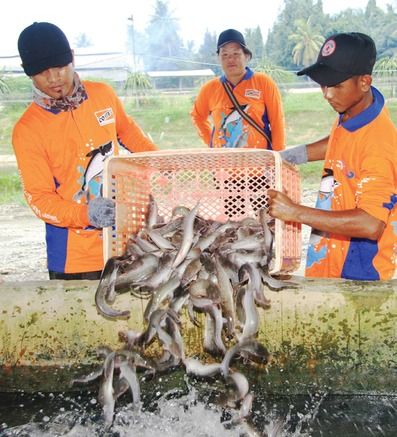
The most accurate way to calculate a daily catfish feeding amount is based on the total weight of all the fish in the pond technically referred to as biomass not on guesswork or habit. The daily feed amount is expressed as a percentage of that total weight, and the percentage decreases as the fish grow older. Simply put, small catfish or fry are fed around 5 to 7 percent of their body weight per day. That figure drops to around 3 percent once the catfish start to grow larger, then settles at 2 to 3 percent as harvest approaches. Feeding frequency also follows the same pattern: 4 to 5 times per day for fry, and 2 to 3 times per day for adult catfish. This straightforward principle is the foundation of any practical, cost-efficient daily catfish feeding chart.
Why does the feed percentage need to decrease over time? Because young catfish grow at a very fast rate and nearly all of their food goes toward growth, so the portion is large relative to their body weight. As they mature, growth slows and some of the feed is used simply to maintain the body rather than build it. When the ratio is off, feed either goes to waste if there is too much, or the fish grow too slowly if there is too little. Since feed accounts for 60 to 70 percent of production costs, getting the amount right is the single most important factor in determining whether a farmer turns a profit.
Why the Feeding Rate Decreases as Catfish Age
A catfish’s feed requirement is never constant. At the fry stage, the fish’s body is working at full speed and almost everything it eats goes toward growth, so the portion is large relative to its weight. As it matures, growth slows and part of the feed is used simply to keep the body healthy. Feeding 5 percent of body weight is perfectly reasonable for fry, but it becomes a serious waste if applied to catfish that are nearly ready for harvest.
The daily feed amount expressed as a percentage of body weight has a technical name: feeding rate. Think of it as a natural brake that prevents overfeeding. To understand the full farming cycle from the beginning, you can also read the guide on catfish farming from fingerling to harvest.
Daily Catfish Feeding Guide by Growth Stage
The following guide can be used as a starting reference. The exact figures still need to be adjusted based on water temperature, stocking density, and the catfish’s appetite.
Fry stage (1 to 5 grams): feed fine powder or crumble at 5 to 7 percent of body weight, 4 to 5 times per day.
Early grow-out (5 to 50 grams): feed small floating pellets at 4 to 5 percent of body weight, 3 to 4 times per day.
Mid grow-out (50 to 100 grams): feed medium pellets at 3 percent of body weight, 2 to 3 times per day.
Pre-harvest (over 100 grams): feed large pellets at 2 to 3 percent of body weight, 2 times per day.
One important note: notice the pattern. As the fish age, the feed percentage decreases, pellet size increases, and feeding frequency goes down. This guide is not a rigid set of rules. Catfish stocked at high densities in cooler water may eat less than the figures above suggest.
How to Recalculate Feed Amount Based on Fish Weight
Fish weight changes every day, so feed amounts need to be updated accordingly. Every 10 to 14 days, weigh a sample of several dozen catfish and find the average weight. Multiply that average by the estimated number of fish still alive to get the total biomass. Then multiply the result by the feeding rate percentage for the current growth stage.
For example: if there are 3,000 catfish in the pond with an average weight of 40 grams, the total biomass is 120 kilograms. At this stage the feeding rate is around 4 percent, so the daily feed allowance comes to approximately 4.8 kilograms, divided across 3 to 4 feedings. Two weeks later, when the average weight has increased, repeat the same calculation using the adjusted, lower percentage.
This habit of recalculating is what keeps the FCR efficient. FCR, or feed conversion ratio, measures how much feed is consumed to produce one kilogram of catfish. The lower the number, the more efficient the operation. If you are not yet familiar with how it works, read up on what feed conversion ratio is and how to calculate it before evaluating your harvest results.
Matching Pellet Size to Mouth Opening
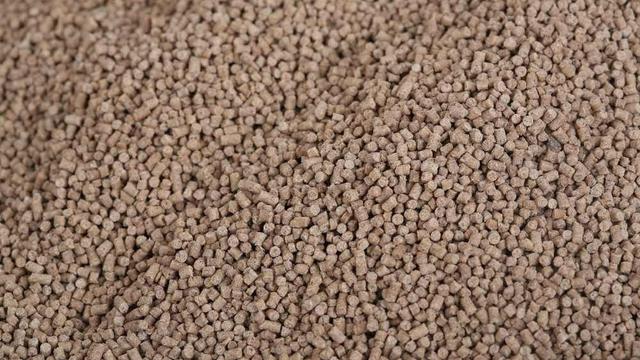
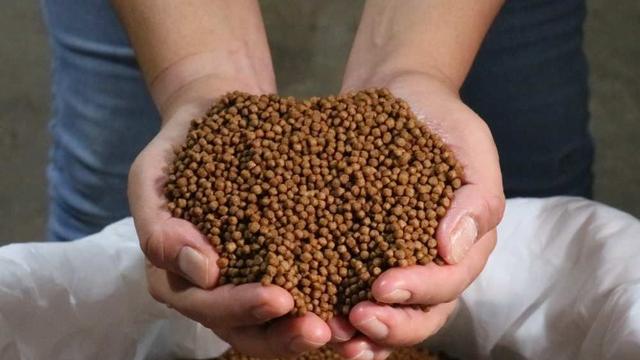
Getting the amount right means nothing if the pellet size is wrong. Pellets that are too large cannot be swallowed by fry and simply sink to the bottom. On the other hand, pellets that are too small for adult catfish make the fish burn unnecessary energy darting after feed repeatedly. The rule of thumb is simple: pellet size should be slightly smaller than the fish’s mouth opening.
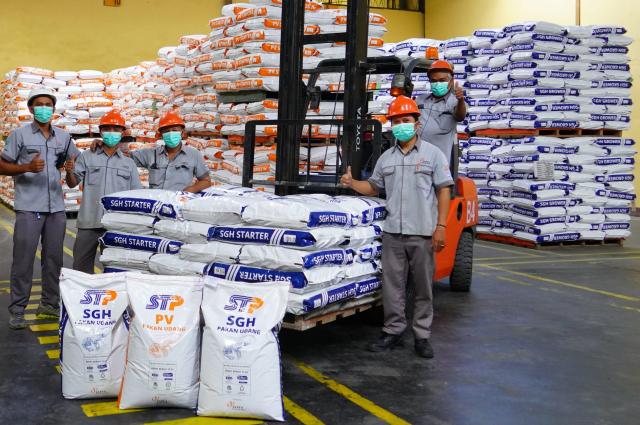
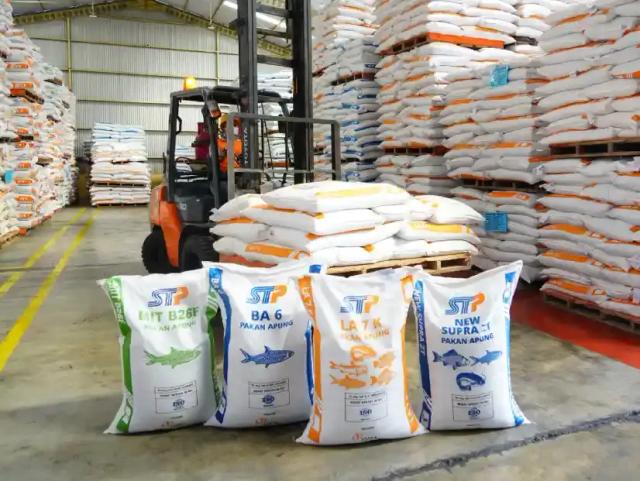
For this reason, fry are fed fine powder or crumble, then progress to small pellets, medium pellets, and large pellets as they grow. STP, which has been producing fish and shrimp feed since 1987 as part of JAPFA, offers a full range of catfish feed for every growth stage including PA Gold for the early phase, and SPLA, LA 7K, and PAE for the grow-out phase. Sizes can be matched to your pond’s current stage through the STP catfish feed catalog.
The Risks of Overfeeding
Feeding beyond the recommended amount is the mistake most likely to eat into profits. Uneaten feed settles on the bottom, decomposes, and releases ammonia a substance that poisons the pond water. Dirty water stresses the catfish, reduces their appetite, and makes them more vulnerable to disease.
The effects then ripple through the FCR. The more feed that goes to waste, the more feed it takes to produce one kilogram of fish, and costs climb without a matching increase in yield. The signs of overfeeding are easy to spot: pellets still floating several minutes after feeding, and water that turns cloudy and starts to smell quickly. If this happens, reduce the portion and monitor the fish’s feeding response again.
The core principle behind any daily catfish feeding chart comes down to one idea: feed as a percentage of total fish weight, decreasing from around 5 to 7 percent at the fry stage to 2 to 3 percent near harvest. Combine the right percentage with age-appropriate feeding frequency, routine weighing every 10 to 14 days, and the correct pellet size, and feed will convert into fish weight rather than waste. If you want to put together a feeding schedule and feed types suited to your pond conditions, the STP technical team is available to help.
FAQ
How much feed should catfish receive as a percentage of body weight per day?
The general benchmark is 5 to 7 percent of body weight for fry, dropping to around 3 percent during the grow-out phase, and 2 to 3 percent as harvest approaches. These figures need to be recalculated every 10 to 14 days to keep up with the fish’s increasing weight.
How many times a day should catfish be fed?
Catfish fry should be fed 4 to 5 times per day so that nutrients are absorbed more evenly. Once they enter the grow-out through pre-harvest phase, 2 to 3 times per day is sufficient, as long as the schedule stays consistent.
What are the signs that catfish are being overfed?
The signs are pellets still floating several minutes after feeding, and pond water that quickly turns cloudy and smells. This condition raises both ammonia levels and the FCR. Once spotted, reduce the portion immediately and adjust it to match the fish’s current growth stage.