Functions & Benefits of Paddlewheel Aerators in Shrimp Ponds
General • 2026-06-30
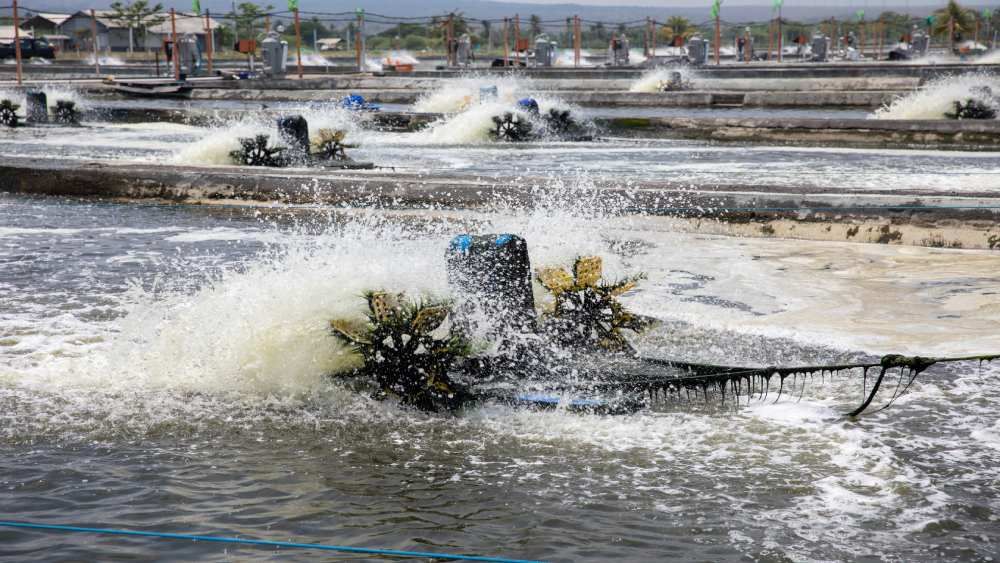
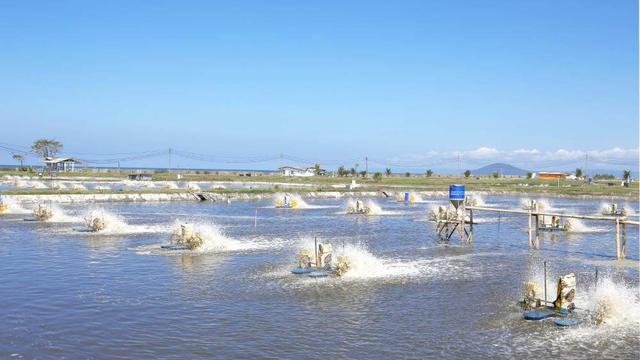
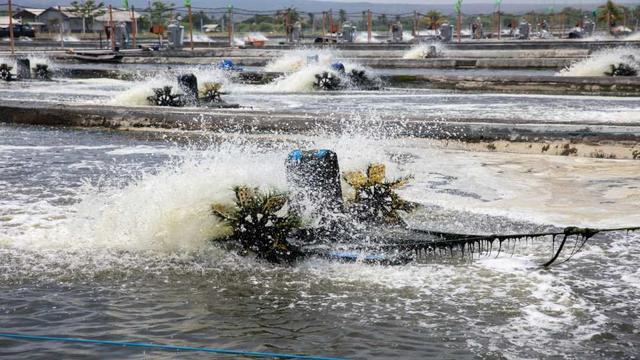
A shrimp pond paddlewheel is a crucial component in Indonesia's intensive Vannamei shrimp farms. Its blades may only spin on the water's surface, but its work simultaneously tackles four critical aspects: maintaining dissolved oxygen, driving water currents, centralizing sludge, and releasing toxic gases into the air.
This article breaks down the functions of paddlewheels, their measurable operational benefits, formulas for determining the required number of units based on biomass, proper installation positions, and energy-efficient technology choices for fish and shrimp farmers in Indonesia.
Why is this topic important? Aeration electricity accounts for approximately 15% of the total production costs in intensive Vannamei shrimp ponds (Wafi et al., Saintek Perikanan UNDIP). At the same time, national shrimp stocking densities continue to rise; the Ministry of Marine Affairs and Fisheries (KKP) reports that densities of 750–1,250 post-larvae (PL)/m² are already being implemented in Indonesia's super-intensive ponds. Any miscalculation in the quantity, positioning, or operating schedule of paddlewheels directly impacts the Feed Conversion Ratio (FCR), survival rates, and profit margins per cycle. Before discussing feed or fry, the foundation of aeration must be secured first, especially in ponds running intensive Vannamei shrimp farming with high production targets.
What is a Shrimp Pond Paddlewheel and Why is it Mandatory?
A shrimp pond paddlewheel aerator is an electric-motor-driven mechanical device that rotates blades on the water's surface to perform four main functions: increasing Dissolved Oxygen (DO) levels to ≥4 ppm, generating horizontal water thrust, centralizing sediment towards the central drain, and accelerating the release of toxic gases like ammonia and H₂S into the atmosphere. In intensive Vannamei shrimp farming, industry standards dictate a minimum requirement of 1 HP of paddlewheel capacity for every 500 kg of shrimp biomass.
This technology originated in Taiwanese aquaculture in the 1980s and entered Indonesia alongside the transition from Tiger shrimp to Vannamei shrimp in the early 2000s. Boyd (2021, Journal of the World Aquaculture Society) notes that about four out of the five million tons of penaeid shrimp farmed globally come from mechanically aerated ponds. In Indonesia, paddlewheels are an absolute necessity for ponds with stocking densities above 50 PL/m²—a number that is virtually guaranteed to be met in almost all commercial Vannamei ponds.
How does a paddlewheel differ from other aerators?
- Paddlewheel: Highly versatile, good O₂ transfer, excellent horizontal circulation/thrust, and makes sludge centralization highly effective.
- Root blower + diffuser: Offers the highest oxygen transfer efficiency (Standard Aeration Efficiency, SAE ~3–5 kg O₂/kWh) but has limited vertical circulation and horizontal thrust.
- Nano-bubble diffuser: Provides the best oxygenation efficiency but requires the highest initial investment costs.
- Venturi: Simple design with no gearbox, but has limited capacity, making it suited only for small ponds.
This is exactly why paddlewheels remain the backbone of Vannamei shrimp pond aeration. Their ability to drive sediment to the center of the pond cannot be replicated by other technologies at a comparable cost. Farmers stocking high-quality Vannamei Shrimp Fry at intensive densities practically have no alternative but to design their paddlewheel systems correctly from day one.
4 Main Functions of Paddlewheels in Shrimp Ponds
These four functions are deeply interconnected. Neglecting just one will drag down the cycle's performance, even if the paddlewheels superficially appear to be spinning normally.
- Surface Oxygenation. Paddlewheels transfer atmospheric oxygen into the water column by creating turbulence at the surface layer (via diffusion). The Standard Aeration Efficiency (SAE) of a paddlewheel ranges from 2.6–3.0 kg O₂/kWh under standard freshwater conditions (Boyd, 1998, Aquacultural Engineering). Operational target: DO ≥4 ppm in the early morning and ≥5–6 ppm during the day, in accordance with the Ministry of Marine Affairs and Fisheries Regulation (Permen KP) No. 75 of 2016 regarding Vannamei shrimp pond quality standards.
- Water Circulation. The rotation of the blades creates horizontal currents that prevent temperature and oxygen stratification between the surface and the pond bottom. This circulation also distributes plankton and feed particles evenly, which is crucial for feed efficiency and preventing anoxic dead zones in pond corners.
- Sludge Centralization to the Central Drain. This function is frequently overlooked by beginners. If the paddlewheels are positioned at the correct angle (30–45° relative to the pond wall), the resulting circular current drives feces, uneaten feed, and molted shrimp shells toward the central drain, making bottom waste removal much easier.
- Off-gassing Ammonia and H₂S. Surface agitation accelerates the release of toxic NH₃ and H₂S gases, which are byproducts of shrimp metabolism and decomposing organic matter. Under the Permen KP 75/2016 standards, pond ammonia levels must remain ≤0.1 mg/L—a figure that is incredibly difficult to maintain without active surface aeration.
Note: The oxygen consumption of Vannamei shrimp can double with every 10°C increase in temperature (the Q₁₀ effect). In Indonesian ponds, which often reach 31–32°C during the day, the oxygen demand is much higher than standard textbook calculations based on 25°C.
Operational Benefits: What is Lost When Aeration is Lacking?
Let's talk numbers. At intensive stocking densities of 100–150 PL/m², properly aerated ponds consistently record efficient FCRs. KKP research published in Media Akuakultur noted an FCR of 1.36 at a density of 1,000 PL/m² and 1.40 at 750 PL/m². However, when DO levels frequently drop below 3 ppm, shrimp stop eating, molting is delayed, and the FCR balloons to 1.8 or higher. An FCR discrepancy of 0.4 in an 8-ton biomass cycle equates to an extra 3.2 tons of feed—a cost that immediately impacts the profit and loss statement.
Typical losses when aeration is insufficient can be summarized as follows:
- Early morning DO drops below 3 ppm: Shrimp experience hypoxic stress, their appetite drops, and they become highly vulnerable to Acute Hepatopancreatic Necrosis Disease (AHPND/EMS).
- Temperature and oxygen stratification: The pond bottom turns into an anoxic zone, accelerating the accumulation of highly toxic H₂S, which is lethal even at very low concentrations.
- Uncontrolled sludge dispersion: The central drain becomes ineffective, driving up the workload for pond bottom cleaning between cycles.
- Ammonia accumulation: Shrimp molting is delayed, and the Average Daily Growth (ADG) drops from a healthy range of 0.17–0.25 g/day to <0.1 g/day.
- Declining survival rates: As DO drops, mortality rises and can reach 5–15% in a single mass die-off event.
Ultimately, the economic impact is direct. The FAO notes that a critical DO threshold of 2.7 ppm already causes significant field mortality, and anything <1.2 ppm triggers mass die-offs (FAO Penaeid Manual). Proper aeration ensures that investments in premium Vannamei Shrimp Feed actually pay off. Even the best feed will not be digested optimally if the shrimp are subjected to suboptimal DO levels.
How Many Paddlewheels Are Needed? Formula & Worked Example!
The basic rule is simple: 1 HP of paddlewheel capacity for every 500 kg of shrimp biomass. This figure consistently appears across independent sources. Boyd (2021, JWAS), who audited Asian shrimp ponds, noted a requirement of 2.0–3.33 HP per metric ton, and the SOP from BPBAP Situbondo (KKP) utilizes the exact same figures in its field technical guidelines.
How to calculate it:
- Determine the stocking density (e.g., 100 PL/m²) and pond area (e.g., 0.5 ha = 5,000 m²).
- Estimate the population: 100 × 5,000 = 500,000 shrimp.
- Assume an average harvest weight of 15 g/shrimp → total harvest biomass = 7,500 kg.
- Divide by 500 kg/HP: 7,500 ÷ 500 = 15 HP minimum requirement.
- Add a safety factor of 20–30% to anticipate DO drops and high temperatures: total requirement ≈ 18–20 HP.
- Install this capacity as 9–10 units of 2 HP paddlewheels (or a combination of 2 HP and 3 HP units).
Note from Boyd (2021): Paddlewheels are often operated beyond actual requirements during the first two-thirds of the cycle. During the first month of the blind feeding phase (biomass <500 kg/ha), half of the paddlewheels can be turned off during the day and only run at full capacity from late afternoon until morning. Electricity savings during this phase can reach up to 30–40%.
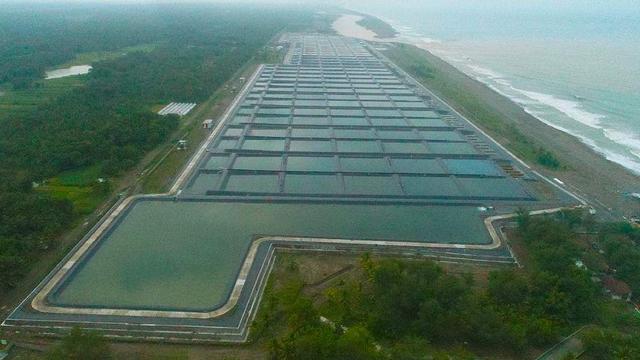
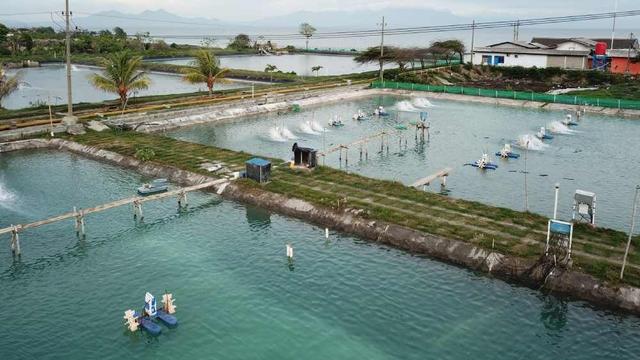
Image Note: Paddlewheel configuration at STP Bomo 1 Pond, Banyuwangi. Image Description: H1 = Reservoir, H2 = Grow-out Pond.
Paddlewheel Positioning & Operating Schedule for Optimal Results
Having enough paddlewheels means nothing if they are positioned incorrectly. The principles for installing paddlewheels in square or rectangular ponds are:
- Angle: 30–45° relative to the pond wall, facing inward. A more perpendicular angle causes currents to collide, while a shallower angle won't push enough sediment toward the center.
- Distance from the embankment: 2–4 meters, to prevent the water spray from eroding the pond walls.
- Blade submersion depth: 8–10 cm below the water's surface, or roughly one-third to one-half the height of the blade. Submerging them too deeply wastes electricity, while too shallow a depth reduces O₂ transfer.
- Distance between units: 8–15 meters, ensuring the current from one paddlewheel feeds into the next, forming a complete circular flow pattern.
For round ponds (which are becoming increasingly popular in Indonesia), paddlewheels simply need to be installed on one side facing the desired current direction, as the pool's geometry naturally aids in forming a circular flow.
The operating schedule should follow the biomass, not the calendar. During the blind feeding phase (Days of Culture / DOC 1–30), running them 12–16 hours/day is usually sufficient. Once the biomass exceeds 50% of the peak target, 20–24 hours/day becomes the standard, especially from 22:00 to 09:00 when photosynthesis stops but respiration continues. The lowest DO point occurs around 05:00–06:00, meaning all paddlewheel units must be fully powered on during this time.
Energy-Efficient Paddlewheels: Modern Choices for Indonesian Farmers
Electricity is the most frequently underestimated cost variable during initial pond planning. Wafi et al. (UNDIP) measured that a 2 HP paddlewheel draws 0.97–1.07 kW during low-load periods and spikes to 1.5–1.9 kW at full load. A 1-hectare intensive pond with sixteen 2 HP paddlewheels running 20 hours/day consumes about 17,000–22,000 kWh/month purely for aeration. When calculated as total energy per ton of shrimp, Boyd (2021) estimates 11.5–28.8 GJ/MT for Asian paddlewheel systems.
Energy-efficient paddlewheel criteria to consider when purchasing:
- Motors with an IE3 efficiency rating or higher.
- Propellers (blades) with a hydrodynamic profile, rather than generic flat plates.
- Brackish-water-resistant bearings with double seals.
- Anti-corrosive bodies (stainless steel frames or food-grade HDPE).
- Gearboxes that use oil easily found in the local market, keeping routine maintenance cheap.
For the Indonesian context, STP's ATD (Aquaculture Technology Development) Department in West Java has developed two aerator variants tailored to the electricity supply and brackish water conditions of national fish and shrimp ponds.
The AT21 ME500 is designed for small-to-medium ponds (typically <0.5 ha intensive) featuring a compact motor suitable for farmers managing multiple separate plots. Based on third-party data from the WWF Indonesia Aquaculture Challenge, the oxygenation capacity for the 2 HP variant is estimated at around 6,000 L/minute with a power requirement of 500–2,200 watts. These numbers are indicative and should be confirmed directly with the STP technical team for official specifications.
Secondly, the AT21 ME1500 provides a higher capacity for medium-to-large ponds (≥1 ha intensive), with an indicative oxygenation output of about 12,000 L/minute on the 3 HP variant. In ponds with massive peak biomass and a target DO of ≥4 ppm in the early morning, higher-capacity units allow for fewer paddlewheel installation points while maintaining the same total HP.
Both AT21 models were developed by STP's ATD, a division focused on on-farm technology for Indonesian farmers, complementing STP's total range of solutions alongside feed, fry, and on-ground technical support.