AHPND, or Acute Hepatopancreatic Necrosis Disease, is more commonly known among farmers as EMS (Early Mortality Syndrome) a bacterial disease that attacks the shrimp’s hepatopancreas and can trigger mass mortality within the first month after stocking.
The cause is a specific strain of Vibrio parahaemolyticus carrying plasmid pVA1, an extra piece of genetic material that enables the bacteria to produce the toxins PirA and PirB, which destroy the hepatopancreas. The symptoms are fairly characteristic: shrimp stop eating, their intestinal tracts are empty, and the hepatopancreas turns pale and shrinks in size. Mortalities can begin as early as eight days after stocking and approach 100 percent within 20 to 30 days. Prevention, fortunately, is fairly clear: disease-free shrimp seed, strict biosecurity, proper pond bottom preparation, water that has matured before stocking, and a reasonable stocking density.
This disease deserves careful attention precisely because of how fast it moves. Unlike conditions that develop slowly and give farmers time to react, AHPND can wipe out a pond before the farmer has a chance to determine what is happening. The sections below cover the cause, field-level signs, and the prevention steps that make the most practical sense to put in place.
Why it is called early mortality syndrome
The name EMS comes from its pattern of attack. Mortality occurs during a period that is generally considered low-risk: the first month after shrimp are stocked, when they are still small and farmers are not yet paying much attention to disease symptoms.
EMS was the initial name, given based on field observations of the symptoms. Once the cause was identified, the scientific name AHPND was adopted to refer to the same disease more precisely. The two terms point to the same condition, just from different angles one from the symptom side, one from the cause.
Vibrio itself is a bacterium that naturally inhabits brackish and marine water, including nearly every shrimp pond, so its presence alone is not inherently a bad sign. What sets the AHPND-causing strain apart is the additional genetic payload it carries.
A scientific review published in the journal Toxins (2021) explains the mechanism concisely: the AHPND-causing strain carries plasmid pVA1, which encodes two toxins, PirA and PirB. These toxins damage the cell walls of the hepatopancreas, causing the cells to break down one by one until the shrimp’s digestive organ stops functioning.
What makes this disease difficult to control through any single measure is that the toxin-carrying plasmid has also been found in several other Vibrio relatives. Prevention therefore cannot be limited to avoiding one specific bacterium, it has to be comprehensive, from clean shrimp seed all the way through water and pond bottom management.
Signs observed in the pond
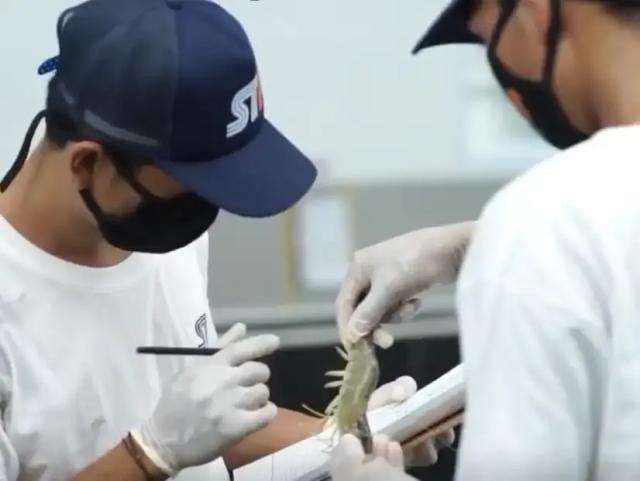
AHPND symptoms are fairly consistent and can be recognized without laboratory equipment, though a definitive confirmation still requires a PCR test at an aquatic health laboratory.
- Shrimp stop eating. Feed trays appear full even though they were consistently clean before.
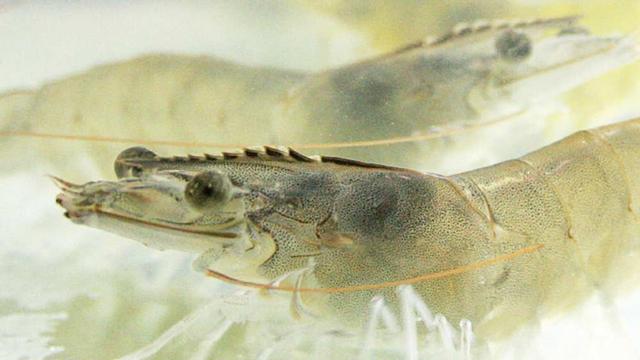
- The intestine and stomach are empty. The dark line along the shrimp’s back, which is normally filled with food, appears broken or absent.
- The hepatopancreas turns pale to whitish, shrinks in size, and feels softer than normal.
- Shrimp appear lethargic, swim slowly along pond edges, and then die and settle to the pond floor.
- Shells tend to be soft and growth stops.
Because several of these signs resemble other conditions, comparing them against a list of common shrimp diseases can help narrow down the most likely cause before samples are sent to a laboratory.
Where this disease comes from
AHPND was first recorded as causing major losses in China in 2009, then spread to Vietnam (2010), Malaysia (2011), Thailand (2012), Mexico (2013), the Philippines (2015), and South America (2016). Its spread has followed the movement of shrimp seed and cross-border shrimp trade.
The scale of damage has been substantial. Various estimates compiled in aquaculture literature put the combined global shrimp industry losses from AHPND between 2010 and 2016 at over 40 billion US dollars, spanning farm-level losses to declines in export volume. In some of the worst-affected regions, shrimp production fell to roughly 60 percent of pre-outbreak levels.
The most critical prevention steps
There is no reliable treatment for AHPND once an outbreak is underway. All efforts therefore rest on prevention. The following are the most impactful measures.
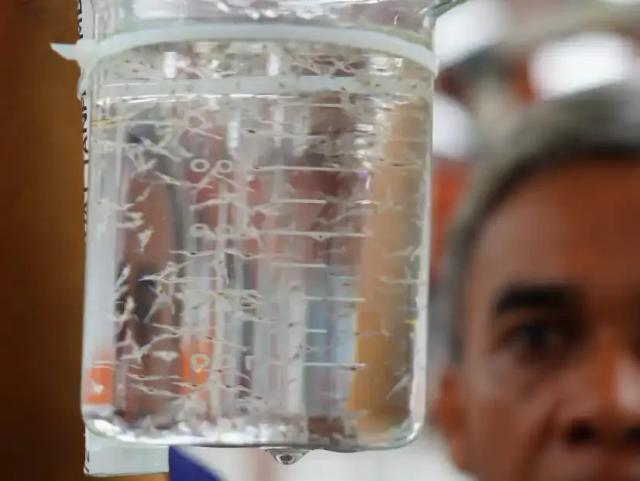
Start with disease-free shrimp seed. Seed from a hatchery with rigorous disease controls and a clear testing history is the first line of defense. Traits worth checking before purchasing: active and responsive movement, uniform sizing within a single container, and no disease history at the source hatchery. A guide on selecting quality vannamei shrimp seed can serve as a useful reference before placing an order. STP’s Super PL seed, for example, is raised to the PL30 stage in a biosecure hatchery, resulting in greater size uniformity and better resilience at stocking, one of the most practical ways to start a vannamei operation with more manageable risk.
Prepare the pond bottom properly. Remove black sludge left from the previous cycle, dry the bottom, and apply lime. For sterilizing the bottom and equipment, STP’s Perosolv which combines nano silver with hydrogen peroxide can be used to suppress bacteria, fungi, and biofouling with minimal environmental impact.
Do not stock into freshly sterilized water. This is a finding that often surprises new farmers. A review by De Schryver, Defoirdt, and Sorgeloos in the journal PLOS Pathogens (2014) found that completely sterilizing the pond bottom and water can actually accelerate the spread of AHPND rather than contain it, because fast-growing bacteria like Vibrio lose their natural competitors. Conversely, green water systems rich in algae have been shown to lower Vibrio levels and reduce shrimp mortality. So after sterilization, allow the water to mature first — typically five to seven days — until a healthy microbial and plankton community has established itself before stocking.
Filter incoming water and control traffic. Use a settling pond to allow particles to settle, filter water through fine mesh, and restrict the movement of people, nets, and equipment between ponds. Equipment should not be shared between ponds without being cleaned first.
Stock at a reasonable density. Densities that exceed aeration capacity cause shrimp stress and accelerate disease transmission. Staying below maximum capacity costs far less than managing an outbreak later on.
Use probiotics routinely. Beneficial bacteria that establish dominance early will make it harder for Vibrio to proliferate. Probiotics from the Bacillus and Lactobacillus groups are among the most extensively studied approaches for suppressing AHPND.
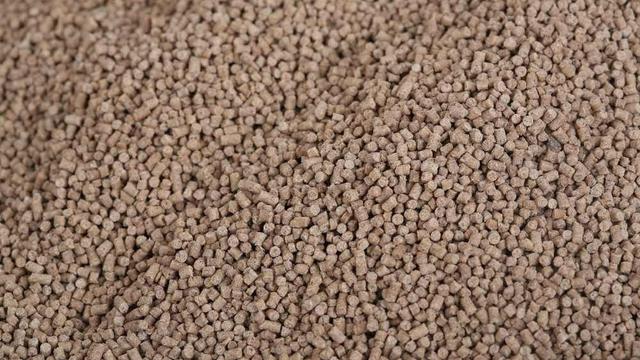
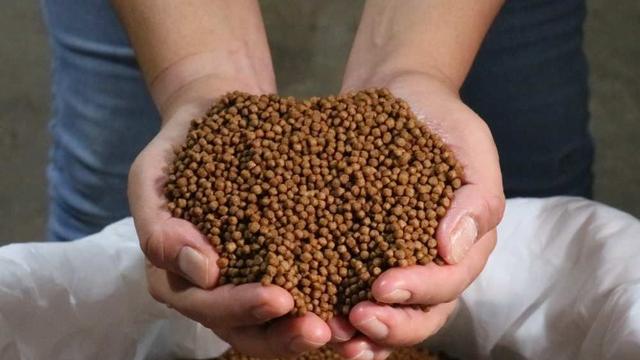
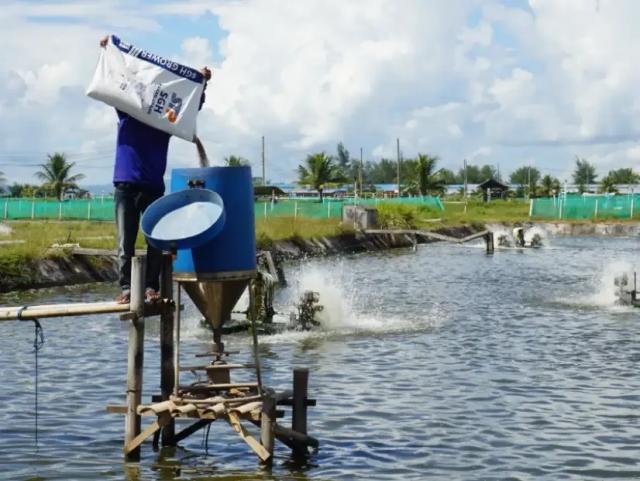
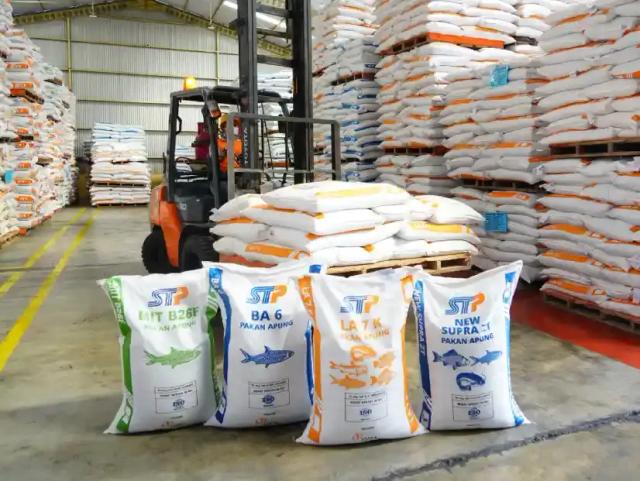
Manage feed quality and portion size. Feed residue accumulating on the pond floor is a food source for harmful bacteria, including the Vibrio strains responsible for AHPND. Providing high-protein shrimp feed at the right portions actually helps maintain shrimp immune function while reducing the organic load in the water. STP’s phase-based shrimp feed lines are formulated per growth stage so that nutrition is on target and portions are easier to manage.
Taken together, all of these steps are an investment, not simply added costs. Preventing AHPND from the outset costs far less than absorbing the losses from a failed harvest and that is one of the key factors in keeping a vannamei operation profitable from one cycle to the next.
One point worth stating plainly: antibiotics are not the answer. Beyond being inconsistent in their results, antibiotic use promotes the emergence of resistant bacteria and risks cutting off access to export markets.
When a pond is already affected
Once early mortality is occurring, stop feeding to reduce the organic load, increase aeration, and immediately send shrimp samples to an aquatic health laboratory for confirmation. Do not discharge infected pond water directly into common drainage channels, as this risks spreading the disease to neighboring ponds. After an emergency harvest or complete pond emptying, carry out thorough drying and sterilization before beginning the next cycle.
AHPND is a serious disease, but its patterns are now well understood. Clean shrimp seed, matured water, well-maintained pond bottoms, controlled stocking density, and measured feeding are the combination that has been most consistently effective at holding this disease in check. To develop a prevention plan suited to your specific pond conditions, STP’s technical team has been supporting farmers on-site since 1987 as part of JAPFA, and the foundational principles can be explored through STP’s vannamei shrimp aquaculture guide.
FAQ
What is the difference between AHPND and EMS?
Both refer to the same disease. EMS was the initial name based on its field symptoms early mortality in the first month after stocking. AHPND is the scientific name adopted after the cause and the specific organ damage were identified.
When does AHPND typically strike?
Usually within the first month after stocking. Mortalities can begin as early as eight days after the shrimp are introduced, then peak within 20 to 30 days, with mortality rates that can approach 100 percent.
Can AHPND be treated?
There is no reliable treatment once an outbreak is underway, and antibiotics are not a viable solution since they promote resistance and pose risks for export markets. The most effective approach remains prevention, from clean shrimp seed and matured water before stocking to strict biosecurity and controlled stocking density.
Does preventing AHPND make vannamei shrimp farming more profitable?
Yes. The cost of prevention measures such as quality shrimp seed, probiotics, and good feed is far lower than the losses incurred from mass mortality. For those just starting out in vannamei farming, building prevention habits from the very first cycle is the single most important step toward stable and profitable harvests.