How Many Post-Larvae for One Hectare? A Practical Guide to Vannamei Stocking Density
General • 2026-09-23
There is no single answer to how many post-larvae one hectare of pond needs, because everything depends on the stocking density you choose. As a starting point, one hectare equals 10,000 square meters. A traditional system stocking 5 to 10 per square meter needs 50,000 to 100,000 post-larvae. A semi-intensive system at 30 to 60 per square meter needs 300,000 to 600,000. An intensive system at 100 to 150 per square meter needs roughly 1 to 1.5 million. Super-intensive operations, which stock above 200 per square meter, can require more than 2 million for the same area.
Those figures are only the opening move. The density a given farm can safely carry is set by its aeration capacity, water quality, target harvest size, and how much working capital it has for feed. What follows is how to work the number out step by step, how to build in a margin for survival rate, and what goes wrong when a pond is stocked past what it can support.
The Basic Formula and the Part People Skip
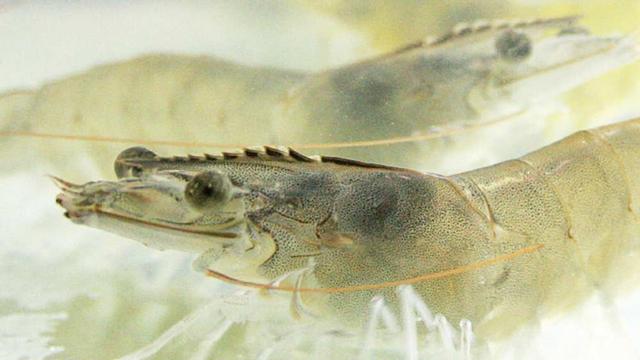
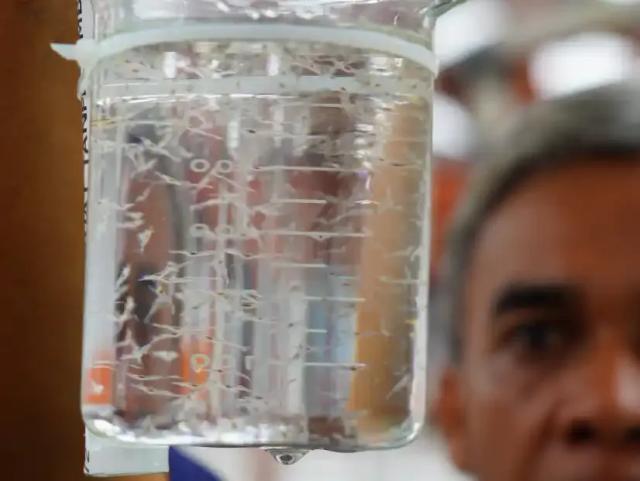
Post-larvae, often shortened to PL, are juvenile vannamei shrimp only a few millimeters long. Stocking density refers to how many of them go into each square meter of water surface.
The formula itself is straightforward:
Number of post-larvae = effective pond area (square meters) x stocking density (PL per square meter)
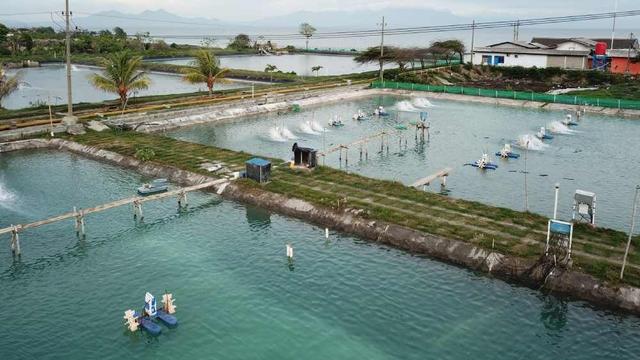
The word that gets overlooked is “effective.” A hectare of land is rarely a hectare of water. Dikes, inlet and outlet channels, and inspection roads all take up space. If the actual water surface is 8,000 square meters, then 8,000 is the number that belongs in the calculation, not 10,000. Measuring the effective water area first is the simplest way to avoid overstocking on day one.
Density Ranges by Production System
Each system carries a different load. These are the ranges commonly used in the field:
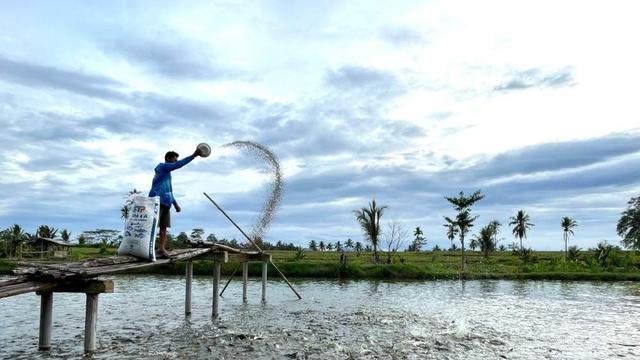
- Traditional or extensive: about 5 to 10 PL per square meter, relying on natural feed, minimal aeration, and tidal exchange.
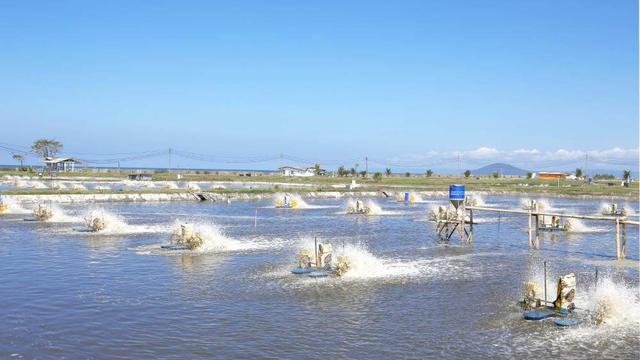
- Semi-intensive: about 30 to 60 PL per square meter, with paddlewheels and formulated feed in use but well short of intensive density.
- Intensive: about 100 to 150 PL per square meter, with aeration running most of the day and feeding on a fixed schedule.
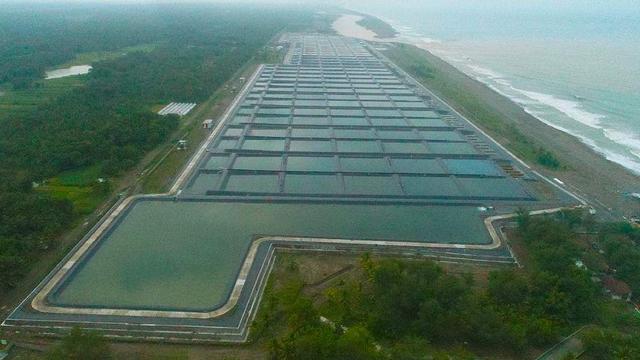
- Super-intensive: above 200 PL per square meter, usually in small lined or concrete compartments with heavy water treatment.
The system you choose does more to shape the final number than anything else. Before settling on a figure, it is worth understanding how each vannamei production system behaves and matching it to the ponds you actually have.
Worked Examples
Take an intensive pond with 10,000 square meters of water at 100 PL per square meter. That works out to 10,000 x 100, or 1,000,000 post-larvae.
If the real water surface is only 8,000 square meters, the requirement drops to 800,000. That difference of 200,000 animals matters, both for the seed bill and for the load the pond has to carry.
On a smaller scale, a semi-intensive pond of 5,000 square meters at 40 PL per square meter needs 200,000 post-larvae.
Building In a Margin for Survival Rate
Survival rate is the percentage of shrimp that make it to harvest. Not every post-larva stocked will get there. Some are lost while acclimating to temperature and salinity, others during grow-out.
A practical way to size the order is to work backward from the harvest target. If you are aiming to harvest 700,000 shrimp and expect an 80 percent survival rate, you need 700,000 divided by 0.8, or 875,000 post-larvae.
Most farmers also add a 5 to 10 percent buffer on top of the base figure, as long as the total still sits below what the pond can carry.
What to Weigh Before Fixing the Number
Several factors deserve a look before the order goes in:
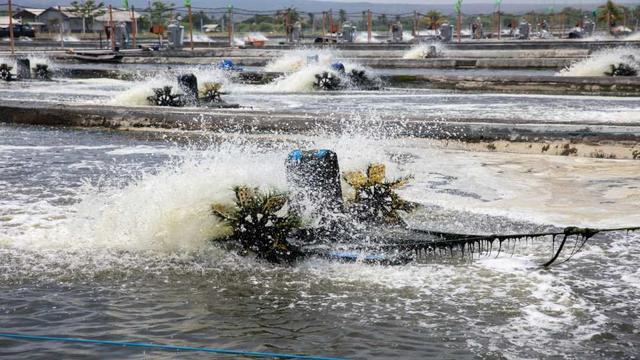
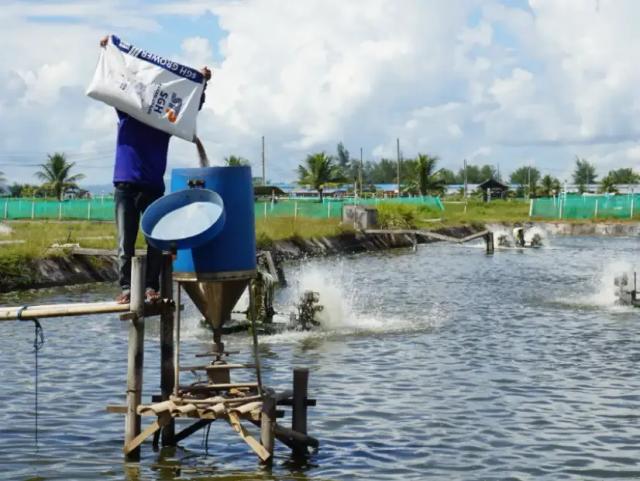
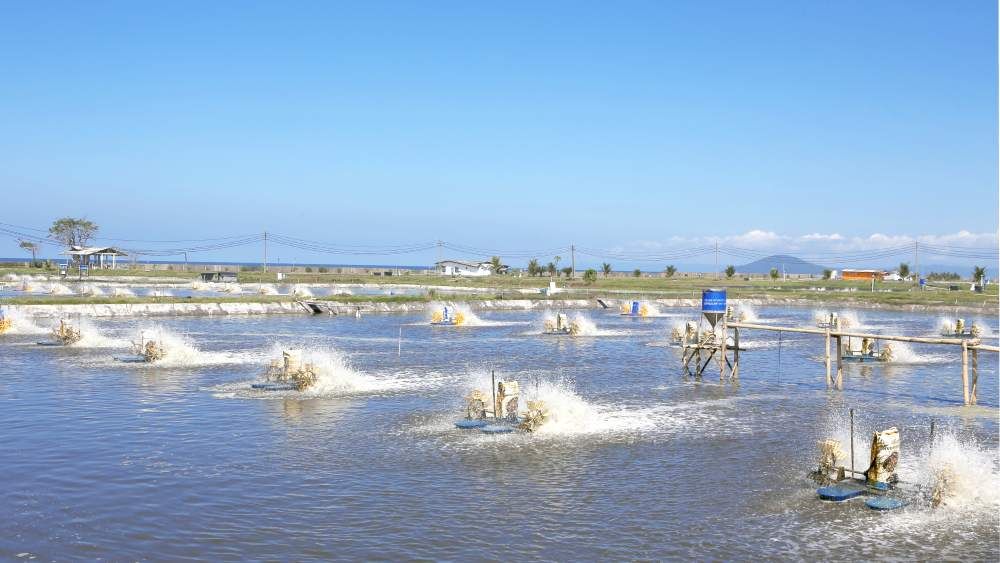
- Aeration capacity. Aeration is the process of getting oxygen into the water, usually through paddlewheels. The number and power of those units decides how many shrimp a compartment can hold comfortably.
- Water availability and quality. A limited source makes it hard to exchange water when pond conditions start to slide.
- Target harvest size. Larger shrimp need more room than mid-size targets.
- Operator experience. High density demands daily monitoring, disciplined feeding, and a quick response to early disease signs.
- Working capital for feed. Feed absorbs the largest share of the budget, so stocking heavily without the cash to feed the pond stalls growth midway through the cycle.
What Happens When You Stock Past Your Aeration
Adding more post-larvae looks like the quickest route to a bigger harvest. In practice it often does the opposite. Dissolved oxygen can fall sharply, particularly in the early hours of the morning. Uneaten feed and waste pile up faster, ammonia climbs, and the shrimp come under stress. Stressed shrimp are far more vulnerable to disease, and in a crowded compartment it spreads quickly.
What you end up with is slower growth, an uneven harvest size, a bloated feed bill, and a higher chance of an emergency harvest. Stocking slightly under your aeration capacity is far safer than pushing for the maximum. Experienced operators treat stocking density as the first decision of the cycle, not the last one.
Seed Quality Counts as Much as Quantity
Stocking a million poor-quality post-larvae can end worse than stocking 800,000 healthy, uniform ones. Weak seed tends to drop off in the first few weeks, and once the survival rate misses your estimate, every calculation behind it stops being useful.
Super PL from STP is one example of vannamei post-larvae raised to PL30 in a hatchery under strict biosecurity. The advantages are more uniform size, better resilience at stocking, and a harvest that can come roughly 20 days earlier than with standard PL. A guide to selecting vannamei post-larvae is worth reading before you place an order.
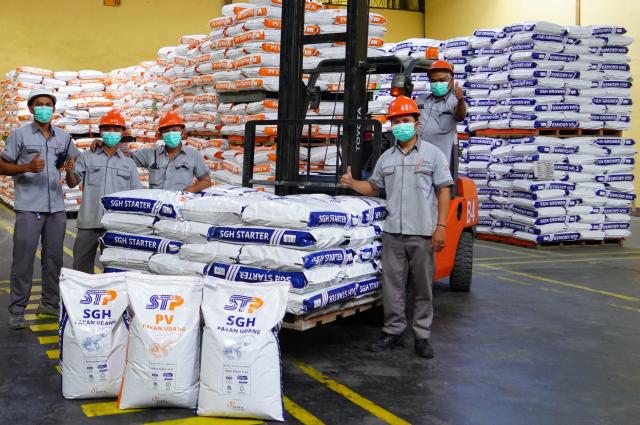
Once the shrimp are in the water, feed takes over as the main driver of the outcome. STP, operating since 1987 and part of JAPFA, produces vannamei feed for every stage of the cycle, from STP PV early on, through STP SGH and STP SGH MAX during grow-out, to STP TOV approaching harvest. The broader STP feed range follows the nutritional requirements of each growth phase.
Working out how many post-larvae a hectare needs starts with one multiplication: effective water area times stocking density. Traditional systems land around 50,000 to 100,000, semi-intensive systems 300,000 to 600,000, and intensive systems roughly 1 to 1.5 million. Adjust that figure against your aeration capacity, water quality, and feed budget, then add a reasonable survival buffer. A realistic number paired with good seed will out-earn a heavy stocking that the infrastructure was never ready to support.
FAQ
How many post-larvae does a one-hectare intensive pond need?
At 100 to 150 PL per square meter, a 10,000 square meter intensive pond needs roughly 1 to 1.5 million post-larvae. Reduce that figure if the effective water surface is smaller than a full hectare.
Does stocking more post-larvae always mean a bigger harvest?
No. Once the number exceeds what your aeration and water quality can support, oxygen falls and disease spreads more easily. The usual outcome is slower growth and a smaller size at harvest.
How much of a buffer should I add?
Generally 5 to 10 percent above the base calculation. Another approach is to work backward, dividing your harvest target by the expected survival rate. Either way, make sure the total stays below what the pond can carry.